Business
Target Guide: History, Strategy, App & Smart Shopping Tips

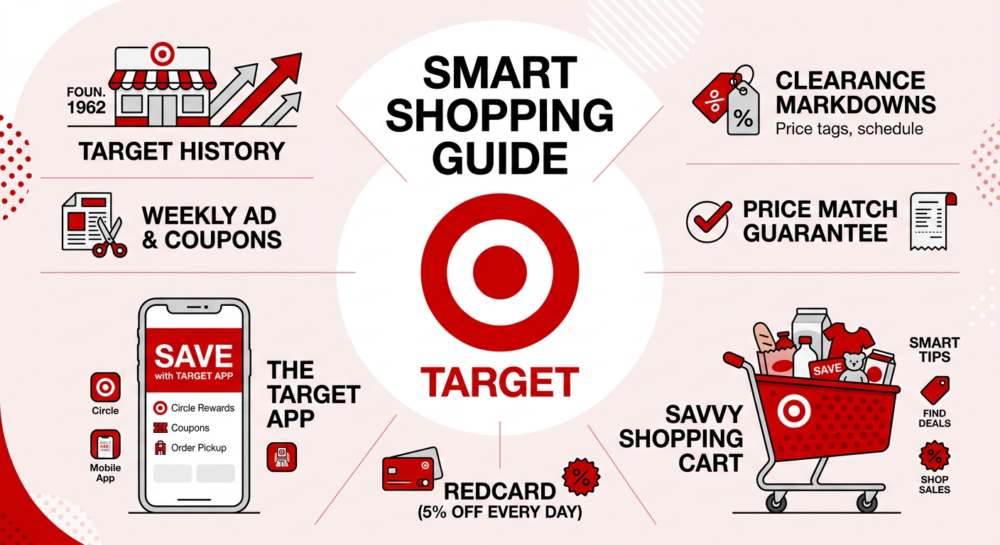
Target is a major U.S. general-merchandise retailer known for design-led products, strong private brands. A store-plus-app model that blends everyday essentials with trend-driven style.
Headquartered in Minneapolis and publicly traded as TGT, it operates as a multi-category discounter. That aims to feel more curated than a pure warehouse club and more accessible than a traditional department store.
For shoppers, Target is often the place for home décor, apparel, beauty, baby gear, and increasingly groceries. With Drive Up, in-store pickup, and same-day delivery layered on top. For investors and retail observers, it is a case study in omnichannel retailing built around stores as fulfillment hubs.
Key Takeaways:
- Target is a U.S. mass retailer positioned around design, value, and convenience
- Owned brands are central to differentiation and margin
- Stores function as fulfillment hubs for pickup and same-day orders
- Circle and Circle 360 shape deals and delivery economics
- Target often wins experience and exclusives; rivals may win pure price or depth
- Smart shoppers mix category strategy instead of one-retailer absolutism
- Omnichannel reliability depends on local store execution
Background: From Dayton’s to the Bullseye?
Target’s corporate roots reach back to 1902, when George Draper Dayton’s dry-goods business began in Minneapolis. The first Target discount store opened in Roseville, Minnesota, in 1962 as a lower-overhead offshoot of the Dayton department-store world. Over time the Target format became the company’s center of gravity, and the modern Target Corporation identity took shape around that red bullseye.
The strategic idea that still defines Target is simple: sell a wide mix of essentials and discretionary goods with more design emphasis than the average mass retailer. That “cheap chic” positioning — later reinforced by designer collaborations and a deep owned-brand portfolio — is why many guests describe Target trips as both practical and recreational.
What Target Sells and How the Business Works?
Target operates as a single retail segment with a broad assortment:
- Apparel and accessories
- Beauty and personal care
- Food and beverage
- Household essentials
- Home décor and hardlines
- Electronics, toys, and seasonal goods
Food and essentials matter strategically because they drive trip frequency. Discretionary categories (home, apparel, décor) support margin and brand perception. Owned brands are a major differentiator; lines such as Good & Gather (food), Threshold and related home brands, up & up (essentials), and All in Motion (active) help Target control design, margin, and exclusivity.
A defining operational choice is store-as-hub fulfillment. Target has repeatedly emphasized that the vast majority of merchandise sales still flow through stores, including digital orders fulfilled from store inventory for pickup and same-day delivery. That model can be cheaper and faster than pure warehouse shipping for many local orders.
Target’s Strategy in Plain Language
Recent company framing centers on a purpose around everyday life and an ambition to be highly “delightful,” supported by priorities such as:
- Merchandising authority — trend-right, design-led assortments
- Guest experience — cleaner stores, easier trips, better service moments
- Technology acceleration — app, inventory, fulfillment, and personalization
- Team and community strength — operations and local presence
In practical shopper terms, that strategy shows up as:
- Strong private-label walls
- Seasonal drops and limited collaborations
- Circle loyalty offers
- Fast fulfillment options tied to nearby stores
- A bet that middle-income households want both value and style in one trip
Target Circle, Circle 360, and the App
Circle Target is the free loyalty layer: personalized deals, a simple barcode/account experience, and ongoing offers designed to reward frequency.
Target Circle 360 is the paid membership tier associated with expanded same-day delivery benefits (often via Shipt) and shipping perks. Pricing and inclusions can vary by cardholder status and promotions, so checking the live app terms matters before subscribing.
Why the app matters:
- Digital deals stack onto in-store trips
- Drive Up and Order Pickup reduce friction
- Same-day options compete with convenience expectations set by Amazon and Walmart+
- Private-brand discovery is easier when offers highlight exclusive lines
The loyalty system is not just coupons. It is a data and habit engine: more trips, more attached categories, more reason to open the app before leaving home.
Same-Day Delivery, Drive Up, and Omnichannel Reality
Target’s convenience stack typically includes:
- In-store shopping
- Order Pickup
- Drive Up (curbside)
- Same-day delivery (often powered with Shipt)
- Standard shipping for broader assortment
The competitive idea is practical: if a store is ten minutes away, “this afternoon” can beat “tomorrow in a box.” Stores become mini distribution nodes. That is one reason Target invests in remodel quality, backroom processes, and inventory accuracy — digital promises fail when shelf data is wrong.
Owned Brands: Target’s Quiet Superpower
National brands bring traffic. Owned brands build identity.
Examples of the strategy at work:
- Good & Gather for everyday food quality at accessible prices
- Favorite Day and opening-price lines for snacks and treats
- up & up for household and care essentials
- Home brands (Threshold and partners/collections) for design credibility
- All in Motion for active lifestyle apparel
Owned brands help Target answer a hard retail question: why should a guest choose this aisle over a competitor’s? When the product looks intentional and is only available at Target, comparison shopping gets harder.
Target vs Walmart vs Amazon (and Others)
| Retailer | Core strength | Typical shopper promise | Weakness to watch |
|---|---|---|---|
| Target | Design + value + convenient stores | “Useful and enjoyable one-stop trip” | Hard to win pure price wars on staples |
| Walmart | Scale + low prices + grocery power | “Lowest practical total basket” | Less “discovery” feel for some categories |
| Amazon | Selection + digital speed + Prime habit | “Everything, delivered” | Weaker tactile discovery for home/apparel |
| Costco | Membership value density | “Bulk value + treasure hunt” | Less convenient for small fill-in trips |
| Best Buy | Consumer electronics depth | “Tech expertise and assortment” | Narrower basket |
| IKEA | Furniture systems + price design | “Plan-and-build home solutions” | Trip friction / store format limits |
| Ulta / Sephora | Beauty authority | “Assortment + services” | Not full multi-category |
| Home Depot / Lowe’s | Home improvement depth | “Project completion” | Not general merchandise |
| Kroger / major grocers | Fresh food frequency | “Weekly food mission” | Weaker non-food design pull |
| Dollar general merchandisers | Extreme proximity value | “Quick low-cost fill-in” | Limited premium/design assortment |
Target’s lane is the middle: not always the absolute cheapest, not the deepest specialist, but often the best combination of style, speed, and household coverage.
Practical Tips for Shopping Target Smarter
- Check Circle offers before you shop — especially on owned brands.
- Use Drive Up for heavy or bulky items — water, pet food, large home goods.
- Compare unit prices on staples — Walmart or a grocer may still win commodity items.
- Lean into exclusives — décor, apparel capsules, and private-label food are where Target differentiates.
- Watch seasonal transitions — clearance timing can be excellent for home and apparel.
- Inspect same-day substitutions — set preferences carefully for grocery.
- Combine trips — beauty + household + one discretionary item is the classic Target basket math.
- Review Circle 360 math — only worth it if you use same-day delivery enough to outpace the fee.
- Use store mode intentionally — the app’s location features help avoid sold-out frustration.
- Keep receipts and recall habits — like any major retailer, product notices happen; account history helps.
Common Mistakes Shoppers Make
- Mistake: Assuming every item is a “deal” because it is at Target
Solution: Separate exclusive design value from commodity price comparisons. - Mistake: Ignoring fulfillment cutoffs
Solution: Same-day and Drive Up windows are inventory- and labor-dependent. - Mistake: Over-subscribing to memberships
Solution: Calculate real same-day frequency before paying for Circle 360. - Mistake: Skipping the app entirely
Solution: Circle offers and inventory checks often change the final total. - Mistake: Treating Target as a full warehouse-club replacement
Solution: For ultra-bulk staples, club formats can still win. - Mistake: Impulse-only seasonal shopping
Solution: Make a room or wardrobe list first; Target’s merchandising is designed to expand baskets.
Pros, Cons, and Balanced Take
Pros
- Strong private-label design identity
- Convenient omnichannel fulfillment from stores
- Broad category coverage for family trips
- Loyalty offers that are easy to use
- Generally pleasant store environment relative to pure discount formats
Cons
- Not always price leader on basics
- Digital and store inventory mismatches can frustrate
- Membership value depends heavily on delivery habits
- Discretionary categories are sensitive to consumer pullbacks
- Experience quality can vary by location and staffing
Balanced verdict
Target is best understood as a habit retailer: it wins when guests trust it for weekly needs and occasional style upgrades. Its durable advantages are owned brands, store proximity, and fulfillment convenience — not a claim to be the cheapest on every SKU.
Future Trends to Watch
- More investment in store experience and remodels as physical locations remain fulfillment engines
- Loyalty tier refinement as Circle and Circle 360 compete with Prime and Walmart+
- Private-label expansion in food, beauty, and home where exclusivity protects margin
- Retail media and marketplace growth around Target’s traffic and data
- Same-day expectations as table stakes rather than a differentiator
- Selective category authority — doubling down where Target can be known for design or quality, not merely availability
The retailers that survive the next cycle will combine price credibility with reasons to care. Target is explicitly trying to stay on the “reason to care” side without abandoning value.
Who Should Choose Target — and When?
| Shopper type | Best use of Target | Better alternative when… |
|---|---|---|
| Busy parents | Essentials + baby + Drive Up | Ultra-bulk formula/diapers may favor clubs |
| Home décor fans | Seasonal drops + owned brands | Custom furniture projects need specialists |
| Style-on-a-budget shoppers | Apparel capsules + collaborations | Luxury fashion needs different retailers |
| Convenience seekers | Same-day / pickup near work or home | Rural areas with weak store density |
| Grocery fill-in shoppers | Good & Gather + quick trips | Large weekly fresh hauls at strong grocers |
| Deal hunters | Circle offers + clearance cycles | Hard price comparison on commodities |
| Gift buyers | Trend-forward, easy in-store browsing | Highly specialized hobby gifts |
| Investors watching retail | Owned brand + fulfillment thesis | Pure e-commerce scale stories differ |
| Students / first apartments | Starter home + basics in one trip | Severe budget constraints may favor dollar formats |
| Beauty experimenters | Accessible brands + exclusives | Pro beauty services need Ulta/Sephora depth |
FAQs
What is Target?
Target Corporation is a major U.S. retailer selling apparel, home, beauty, essentials, food, and more through stores and digital channels.
Is Target cheaper than Walmart?
Not always. Walmart often wins on pure commodity price; Target often competes on design, experience, and exclusive brands.
What is Target Circle?
Target’s loyalty program for deals and offers; Circle 360 is a paid tier tied to enhanced delivery benefits.
Does Target do same-day delivery?
Yes, through its same-day services ecosystem (commonly associated with Shipt), with membership options affecting price and limits.
What are Target’s best private brands?
Popular examples include Good & Gather, up & up, All in Motion, and home lines such as Threshold, though preference is category-specific.
Is Target only in the United States?
Its retail store operations are focused on the U.S. market.
Can I pick up online orders curbside?
Yes — Drive Up / pickup services are a core part of Target’s model where offered.
Is Target a good place for groceries?
It can be strong for fill-in trips and private-label groceries; dedicated grocers may still lead on fresh assortment breadth in many markets.
Conclusion
Target’s enduring appeal is the combination of practicality and taste. It is a retailer built to capture the middle of the shopping week: paper towels and a throw pillow, snacks and a new water bottle, toothpaste and a trend candle. The modern company backs that up with owned brands, a serious loyalty system, and stores that double as delivery nodes.
Shop Target for exclusives, convenience, and curated value. Compare it on staples. Use the app. And judge membership features by your real delivery habits, not the marketing headline.
Quick Summary
Target is a style-conscious general merchandise retailer that competes through private labels, store-based fast fulfillment, and loyalty offers. Use it for convenient multi-category trips and exclusive products; compare staples; and evaluate paid membership benefits against your actual same-day usage.
Short Content Disclaimer
Retail offers, membership prices, store services, and assortment change frequently by location and date. This article is general information, not financial, investment, or purchasing advice. Confirm current details in the Target app or official Target channels before buying or subscribing.
Authority sources:
Company background and strategy points are drawn from Target corporate/historical overviews and recent public reporting on owned brands, Circle services, and store-based omnichannel fulfillment. Always verify live program terms and local store capabilities.
Source: Corporate
Visit More



Financial Advisor Guide: Types, Fees, Fiduciary Rules & How to Choose

Financial Statements Explained: Income, Balance Sheet & Cash Flow

Westlake Financial Review: Auto Loans, Rates, Pros & Cons
-
Finance9 years ago
These ’90s fashion trends are making a comeback in 2017
-
Finance9 years ago
The final 6 ‘Game of Thrones’ episodes might feel like a full season
-
Finance9 years ago
According to Dior Couture, this taboo fashion accessory is back
-
Finance9 years ago
The old and New Edition cast comes together to perform
-
Finance9 years ago
Phillies’ Aaron Altherr makes mind-boggling barehanded play
-
Finance9 years ago
Uber and Lyft are finally available in all of New York State
-
Finance9 years ago
Mod turns ‘Counter-Strike’ into a ‘Tekken’ clone with fighting chickens
-
Finance9 years ago
Disney’s live-action Aladdin finally finds its stars